What is HbA1c, and why the three-month name?
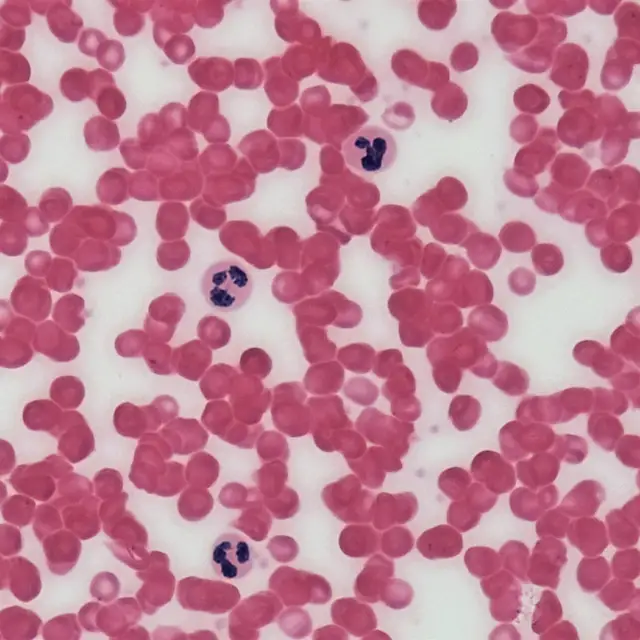
HbA1c is a ratio showing how much of the hemoglobin in your blood has glucose stuck to it. Once glucose attaches it doesn’t come off; the cell carries that trace as long as it lives. Red blood cells live a few months, so the result tells weeks, not a day. Three months is the window where the trace builds up.
Every red blood cell is packed with hemoglobin. When sugar rises, some glucose sticks to this protein and stays; the cell can’t undo the bond. Each cell keeps its own ledger. The lab reads not one cell but the whole crowd’s shared ledger.
Each red blood cell lasts a few months, then a new one replaces it. Your blood holds every age: cells out of the bone marrow yesterday, and cells months old. That’s why the World Health Organization report defines the test as average plasma glucose over the past eight to twelve weeks. The name three-month sugar test comes from there.
| Name on the report | What it means |
|---|---|
| HbA1c or A1c | Standard shorthand for the hemoglobin fraction with glucose bound |
| Glycated hemoglobin | Medical name for the same test; glycated means sugar-bound |
| Glycosylated hemoglobin | Older name; glycated won out since the bond needs no enzymes, yet reports still show it |
| Three-month sugar test | Everyday name for the stretch the measurement covers |
Not every day weighs the same. In Tahara and Shima’s kinetic measurement, HbA1c was a weighted average reaching back a hundred days; recent weeks outweigh distant ones. Distant weeks still sit in the result; the window doesn’t close, it slides.
Not everything that moves the number is sugar. The test reads hemoglobin and red blood cells, so anything touching the blood mixes in. The World Health Organization lists these in a separate annex:
- Conditions that shorten red-cell lifespan (hemoglobin variants, an enlarged spleen, certain drugs) pull the result down.
- Iron or B12 deficiency slows blood production and pulls the result up.
- Removing the spleen keeps cells circulating longer; the result goes up.
- Inherited hemoglobin variants shift the result either way, depending on the lab’s method.
The lifespan itself isn’t the same in everyone. In Cohen and colleagues’ measurement, average red-cell age in people with normal blood counts ranged from thirty-eight to sixty days. Same sugar, different result: only because the cells renew at different speeds; the number tracks the crowd’s average age.
- How is HbA1c pronounced, and what does it stand for?
- Letter by letter: aitch-bee-ay-one-see. Hb is short for hemoglobin; A1c names one of the hemoglobin subfractions the lab separates. A report saying only A1c means the same test.
- How long does HbA1c take to drop?
- Slowly. In Tahara and Shima’s measurement, half the drop took over a month. Weekly retests just show the same window again.
- Why doesn’t my fingerstick average match my HbA1c?
- The two don’t count at the same frequency. Your fingerstick average counts only measured moments; sleep hours and skipped meals stay out. Nathan’s team built the average glucose relationship from frequent, regular fingersticks alongside continuous monitoring. The difference isn’t the fingerstick, it’s the frequency.
Sources
- World Health Organization. Use of Glycated Haemoglobin (HbA1c) in the Diagnosis of Diabetes Mellitus: Abbreviated Report of a WHO Consultation. Geneva: World Health Organization; 2011.
- Tahara Y, Shima K. Kinetics of HbA1c, glycated albumin, and fructosamine and analysis of their weight functions against preceding plasma glucose level. Diabetes Care. 1995;18(4):440-447. doi:10.2337/diacare.18.4.440
- Cohen RM, Franco RS, Khera PK, et al. Red cell life span heterogeneity in hematologically normal people is sufficient to alter HbA1c. Blood. 2008;112(10):4284–4291.
- Nathan DM, Kuenen J, Borg R, et al. Translating the A1C assay into estimated average glucose values. Diabetes Care. 2008;31(8):1473–1478.
- Türkiye Endokrinoloji ve Metabolizma Derneği (TEMD). Diabetes Mellitus ve Komplikasyonlarının Tanı, Tedavi ve İzlem Kılavuzu-2026. 17. Baskı. TEMD; 2026. ISBN 978-625-99759-8-6