Medicines and insulin
Day-to-day use
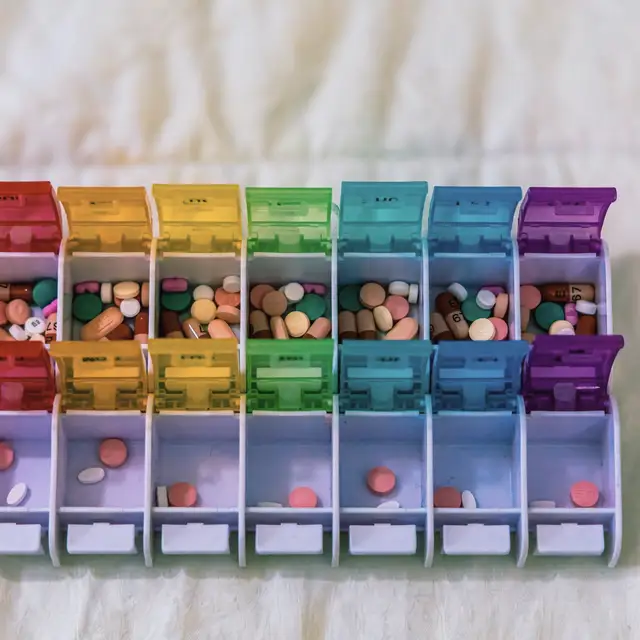 What happens if you miss a medication dose?A missed dose doesn’t mean the same thing with every drug, because how long the effect lasts changes from drug to drug. A pill whose effect runs long and a short-acting drug taken with a meal aren’t equal either. What really decides it is how long the drug stays in the body and the curve its effect draws. · 2 minRead more
A drug isn’t done once it enters the mouth; the body breaks it down slowly and clears it out. That clearing speed has a rough measure: half-life. A long-half-life drug still leaves some in the blood when a dose is skipped; the gap passes softly. With a short one the level falls fast and the in-between opening shows earlier. In two separate drugs, therefore, a delay of the same length produces two results that look nothing alike. In the sources, long-half-life drugs sometimes even get called “forgiving.”
Medications taken with a meal work by another logic. Their job is meeting that meal’s glucose wave. Once the meal passes, so does the wave; the drug has no target left, so the whole equation changes. A late dose therefore doesn’t mean what it means with a long-acting drug.
Two doses stacking up brings its own result. The two effect windows overlap in the same stretch and the total effect grows. In pancreas-stimulating drug families and in insulin, that overlap can pull blood sugar too low; when the effect fades also turns uncertain. With long half-life drugs the picture differs: mathematical modeling finds a much smaller swing here. The two cases don’t fit in one sentence.
| How long the drug acts | What a skipped dose changes |
|---|---|
| Long half-life, falls slowly | What’s left in the blood carries the gap a while; no sudden drop |
| Short half-life, falls fast | The effect ends quickly; the opening shows earlier |
| Taken with a meal | If the meal has passed, so has the load it would meet |
| Injected basal insulin | A flat profile spreads the gap; no crowding into one moment |
Single skipped doses and a settled, ongoing irregularity aren’t the same either. A dose slipping now and then doesn’t weigh enough to set the long-term picture across months alone. A disruption lasting weeks, though, leaves a mark on the three-month average. And that mark isn’t easy to erase. Seeing the difference eases needless guilt.
Forgetting itself isn’t random either; habit leans on repeating cues around you. With the phone alarm on silent, the cue vanishes and the habit chain breaks. Out of sight, the strip’s emptied pockets leave no trace to look back at. When mealtimes slide, so does the cue for the medication taken with them. When the cue returns, the habit recovers too.
From here you see why no single answer for a missed dose fits everyone. Which drug carries which gap, and how far, is shown by its own product information and the team managing the treatment. Talking on a calm day is far easier than trying to decide in the flustered moment the gap gets noticed. The next checkup suits exactly such a conversation.
 Do medications affect each other?What a drug does doesn’t run independently of the other drugs and supplements taken in the same days. Interaction works both ways: a drug can change what a diabetes medication does, or it can move blood sugar on its own. So when a new box joins the list, the whole list matters. · 3 minRead more
Interaction takes two separate routes. On the first, drugs interfere with each other’s clearance from the body; two substances using the same liver enzyme can stretch the other’s stay in the blood. On the second, a substance touches blood sugar directly, either backing or opposing the diabetes medication’s pull. One is more the pharmacists’ concern; the other shows in daily readings.
The group pushing blood sugar up has one best-known member: cortisone-type drugs. They travel the same pathway the body’s own stress hormones use on sick days; a separate post opens it step by step. The effect’s size is proportional to the drug’s strength and length of use. A short course and months-long use don’t weigh the same. Thiazide-group water pills and some mental illness drugs push the same way too.
Some examples work the other way. Certain quinolone-family antibiotics close the potassium channel in the beta cell, prompting insulin release; that’s why low-sugar reports stand out. The same family also produces reports at the opposite end; both directions can appear at once. Beta blockers mostly change the warning, not the effect; some signals the body gives weaken. The result doesn’t look the same, but both blur the picture.
| Interaction type | What happens in the body |
|---|---|
| Pushes blood sugar up | Presses against the diabetes drug’s pull; the trend drifts up |
| Pulls blood sugar down | The beta cell puts out more, or two effects stack up |
| Masks the warning | The effect holds, but the body’s signs weaken |
| Changes clearance | Two substances share the same enzyme; one stretches the other’s stay in the blood |
Interaction is most visible when a drug joins or leaves the list. When a cortisone-type drug ends, the upward force disappears too and the picture turns back. That turn isn’t quiet; the trend in your readings changes direction within a few days. The ending carries as much news as the start.
Herbal products and supplements aren’t outside this list. Plants like ginseng and bitter melon reportedly add a downward pull on blood sugar; taken together with a sugar-lowering drug, the total effect can grow. For gymnema, results are mixed: one study found it cut metformin’s passage into the blood. The word “herbal” doesn’t mean without effect. Active ingredient amounts can also swing from box to box.
Seeing the whole list is harder than assumed. Boxes opened a year ago stay at the back; nobody counts them. A painkiller taken from habit never makes the list. Nobody thinks of an herbal tea either, since it isn’t counted as a drug. A pharmacy record shows only what was bought there. Seeing every box side by side once gathers these scattered pieces.
Most interactions are neither hidden nor a surprise: already recognized relationships named in the sources. Most are in the package insert too. Sharing the whole picture as a new box joins the list prevents a puzzle hard to solve later. The decision sits here: the doctor and pharmacist who see the whole list.
 Why do you change the injection site?Years of injections into the same area quietly change how fast the insulin given there reaches the blood. A small bump may show on the surface, and sometimes no trace shows at all; what changes is the tissue under the skin. That is the real reason the injection site gets changed. · 3 minRead more
Insulin isn’t only a molecule that touches blood sugar. It also carries a growth call to fat cells. If the same small area keeps getting that call for years, its fat tissue both grows in volume and multiplies in number. What appears isn’t a simple “swelling.” One study points to insulin’s fat-building action, not the needle’s injury, as the bump’s main source. Field surveys also name needle tip reuse alongside the hardening; not a mechanism seen there, but a companion tangled up with insisting on the same area.
The changed tissue isn’t like healthy skin in its underlying capillary network. Passage into the blood from there both slows noticeably and differs day to day. The same injection that works as expected one day falls well short the next. This unsteadiness stands out as a quiet source of unexplained ups and downs in readings. Guidelines therefore call regular site checks important.
Reading this as laziness or clumsiness would be wrong from start to finish. Hardening can appear even in people with sound technique; the real decider is how often the same area gets loaded. The suitable surface under the skin is far wider than assumed; most people keep circling a small piece of it. In people who spread the load widely, studies find that share much lower.
| Under healthy skin | Hardened tissue |
|---|---|
| Capillary network dense, blood flow steady | Capillary support weakens, flow turns irregular |
| Absorption follows a predictable line | Absorption both slows and swings day to day |
| Same amount gives a similar result | Same amount can produce different results |
| Needle prick feels normal | Feels easier because sensitivity has dropped |
There’s also a loop that feeds itself. Since the hardened area’s sensitivity has dropped, the needle hurts less there; that easier spot gets picked again without notice. So the tissue keeps growing and absorption grows even less reliable. What starts the loop isn’t pain, it’s habit.
Why the same spot gets picked every time hides in daily life. With the light off, the hand finds the most familiar place by itself. Where clothing slides up most easily becomes the only option over time. When hurry cuts in, the nearest surface comes forward; the far sides of the arm or leg never get a turn. All three leave the same small area under the same load for years.
Lipohypertrophy isn’t rare; it shows up in about half of insulin users. Small, flat bumps escape the eye easily. Feeling by hand at an exam catches a significant share of these areas; ultrasound can show the change even with no surface trace. When an area goes unloaded for a while, the tissue can slowly pull back. But that return isn’t quick, and it lags even more with long-settled bumps. Noticing early is valuable for that reason. Your care team can see where things stand by feeling these areas at a checkup.
 What happens to medications on sick days?A day with fever, vomiting, or diarrhea pulls blood sugar in two directions at once. Illness stress pushes it up; not eating and fluid loss pull it down. Some drugs also act differently on such days, because the body’s fluid balance and kidney speed don’t hold. When balance shifts, the drug’s job shifts too. · 2 minRead more
A feverish infection puts the body on alert, pushing up counter-regulatory hormones like cortisol, adrenaline, and glucagon. They blunt how tissues answer insulin and speed the liver’s sugar production. So being sick carries blood sugar up even without eating. Another force works against this. Vomiting and diarrhea take both food and fluid, pulling the picture the other way.
The real fragile point: running out of fluid. As fluid drops, kidney blood flow falls and the kidney clears substances from the blood more slowly. Drugs leaving mainly through the kidney feel that slowdown directly. Metformin is the best-known example: what normally exits fine builds up in the blood when that exit narrows, straining the lactic acid balance.
SGLT-2 inhibitors follow a separate route. Because this family sends sugar out in the urine, it already raises fluid loss; the illness’s loss stacks on top. There’s a second effect too. It shifts the insulin and glucagon balance, the body turns to fat for fuel, and ketone production speeds up. The resulting acid picture can develop even when the reading doesn’t look high; the literature calls it “euglycemic ketoacidosis”.
Both pictures are rare. Rare doesn’t mean unimportant when conditions stack up. The reason for that fragility varies from family to family; each family’s weak point sits elsewhere.
- Metformin: its exit runs almost wholly through the kidney, which fluid loss narrows first.
- SGLT-2 inhibitor: deepens fluid loss and makes ketone production easier.
- Sulfonylurea: keeps prompting the pancreas; without food, low sugar grows likelier.
- GLP-1 receptor agonist: slows stomach emptying, deepens nausea and loss of appetite.
- Some blood pressure drugs and water pills: push fluid loss and kidney load in the same direction.
- Insulin: reversed on this list; the need doesn’t vanish.
Insulin really does sit elsewhere on this list. During an infection the body’s insulin need doesn’t shrink; most often it grows. Insulin dropping out altogether because the plate stayed empty opens a second door on top of the first problem: the body shifts to burning fat and ketones pile up. So being unable to eat doesn’t zero the insulin need by itself.
Here’s the sum of all this. What happens on a sick day depends on the drug family, kidney status, whether food stays down, and how many days the illness runs. A single general sentence can’t cover these four variables at once. So sick day rules are a ready-made plan the person builds with the care team while healthy. New decisions come hard when fever climbs and sleep is broken. A text written beforehand moves the decision to a healthy day. Some keep that paper in the nightstand drawer, by the thermometer.
 Do diabetes medications make you gain weight?Medications that lower blood sugar don’t leave the same mark on the scale; some never move it, some reverse the direction. The difference isn’t chance; it’s a direct result of the drug’s path in the body. Behind that movement is sometimes appetite, sometimes fluid, sometimes calories no longer lost in urine. · 2 minRead more
Weight is the long-term balance of energy in and out. A drug touches that balance at three doors: how much glucose leaves the body, appetite’s strength, and the tissues’ tendency to store. The door it enters sets the direction. The opening’s width differs from body to body.
| Direction | Which families | Why |
|---|---|---|
| Increase | insulin, sulfonylurea, glitazone | calories no longer leaving, extra eating against low sugar, fat tissue and fluid |
| Neutral | metformin, DPP-4 inhibitor, acarbose | doesn’t move glucose output; metformin tends slightly down |
| Decrease | GLP-1 receptor agonist, SGLT-2 inhibitor | appetite fading, calories leaving in urine |
The first door is no new idea. It’s an old picture reversed. A separate article already covers calories partly lost in urine when sugar runs high. The addition here: treatment pulls sugar down, the leak closes, the same meal now stays in the body. So part of the gain on the scale proves the drug works. The scale rising while readings improve isn’t a contradiction.
The second door is appetite. Insulin and pancreas-stimulating drugs pull blood sugar down; they bring the risk of low sugar along too. Someone who knows that eats extra to stay safe. The literature calls this “defensive snacking”; not a weakness, but an expected behavior pattern.
The third door opens in the tissue itself. Insulin is a storage-supporting hormone. In the glitazone group, fluid retention joins fat tissue widening; the scale doesn’t separate them. So part of the early weeks’ movement is water, not fat. Fluid comes fast and goes fast; fat builds slowly.
The two families on the other side work by other routes. With SGLT-2 inhibitors the door is urine again; calories leave there. On paper the math promises a big loss. The real drop is more modest, because the body partly offsets the gap. GLP-1 receptor agonists work through appetite and stomach emptying; fullness lasts longer.
Reading this table, hold on to one distinction: the drug isn’t the only input. An active day and a day spent mostly sitting don’t go into the same balance. Which notch the belt reaches sometimes says more than the bathroom scale. Weight direction alone doesn’t settle the drug choice; kidney and heart status sit at the same table.
This piece is for information only; it is not a diagnosis, treatment or dosing recommendation. Always make decisions about your treatment together with your doctor.
Start keeping your own record
ForMyGluco keeps your readings, medications and appointments in one place, and prepares a doctor-ready PDF in a single tap.